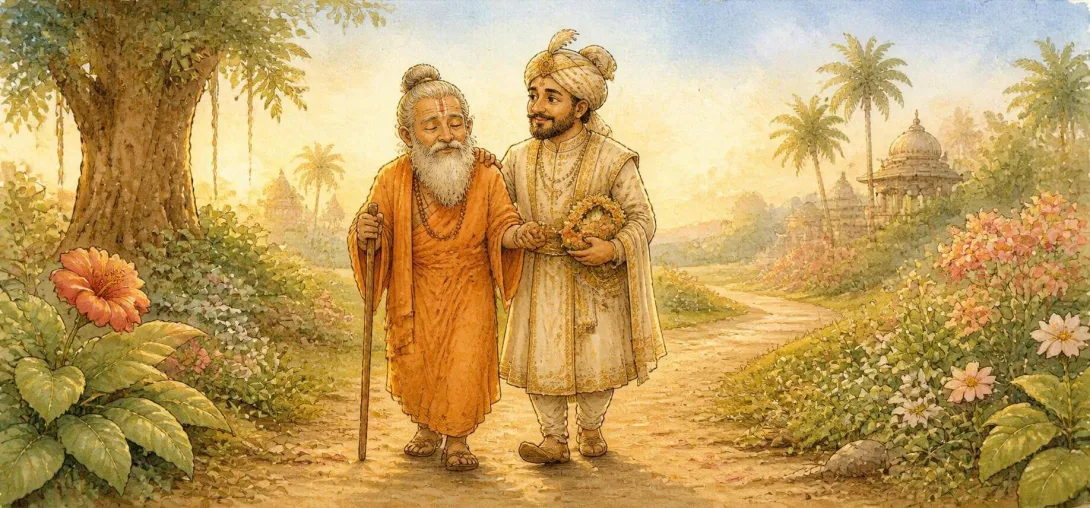
In a small village nestled in the rolling hills of rural India, there lived a wise and venerable sage named Shri Raghavan. He was known far and wide for his extraordinary knowledge and understanding of the natural world. Despite being born blind, Shri Raghavan's other senses were heightened to an incredible degree, allowing him to perceive the world in ways that others could not.
As fate would have it, a powerful king named Maharaja Vikramaditya had heard of Shri Raghavan's remarkable abilities and was eager to meet him. The king was renowned for his just and fair rule, but he was also plagued by a severe curse: he had lost the ability to make decisions on his own, relying heavily on the counsel of others.
One day, Maharaja Vikramaditya arrived in Shri Raghavan's village, accompanied by a large retinue of guards and advisors. He sought out the blind sage with great haste, hoping that he might possess the knowledge needed to break the curse. Shri Raghavan welcomed the king warmly, sensing his turmoil and inner conflict.
As they sat together under a shaded tree, Maharaja Vikramaditya poured out his troubles to Shri Raghavan. The sage listened attentively, absorbing every word with his heightened senses. He asked few questions, but those he did were piercing and insightful. After some time had passed, Shri Raghavan stood up, his eyes closed in contemplation.
"Your Majesty," the sage began, "the curse that afflicts you is not one of weakness, but rather a test of your own inner strength. It is said that true wisdom lies within oneself, and that external guidance can only lead to confusion and doubt." The king listened intently, sensing the truth in Shri Raghavan's words.
With newfound resolve, Maharaja Vikramaditya turned his back on the counsel of others and began to trust his own instincts. Slowly but surely, he regained control over his decision-making, breaking free from the curse that had held him captive for so long. The king returned to his kingdom, wiser and stronger than before.
From that day forward, Maharaja Vikramaditya ruled with a newfound sense of clarity and purpose, never again relying on external guidance but instead trusting in his own inner wisdom. And Shri Raghavan, the blind sage, remained in his village, a symbol of the transformative power of self-discovery and trust in one's own abilities.
💡 Life's Lesson from this story
"Wisdom is not in seeing but in understanding."
🗺️ Cultural Context
📚 Word of the Story
- sage — a wise old person
- philosophy — the study of ideas about life and how to live
- noble — having great goodness, kindness, or generosity
💬 Let's Talk About It
What are some qualities that make a person truly wise, like the Blind Sage in the story?
How do you think the world would be different if everyone was as humble and open-minded as the King in the story?
Can you think of times when someone who is not powerful or famous has made a big difference in your life, like the Blind Sage's influence on the King?