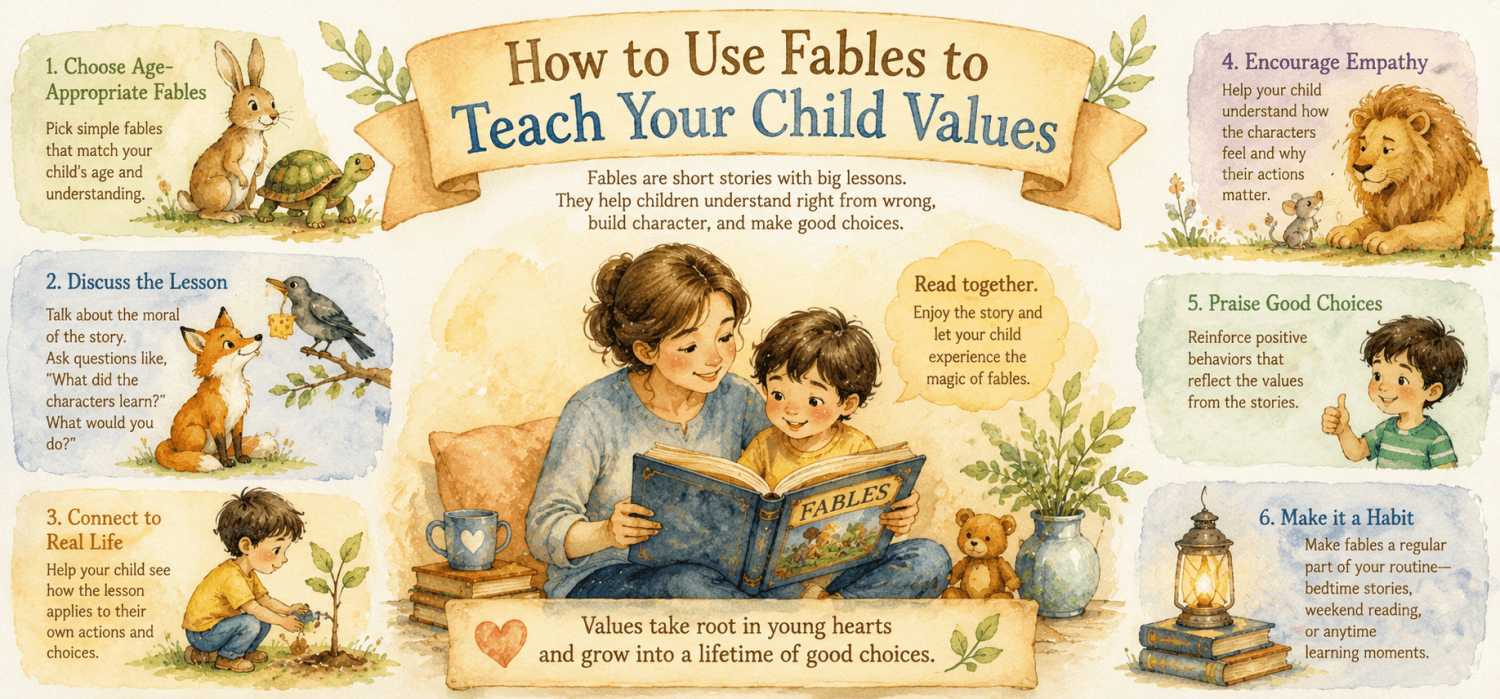
Fables are timeless tools for teaching children about honesty, kindness, courage, and responsibility—but only when used strategically. Parents often struggle with abstract moral lessons, yet children naturally absorb the truths woven into these short, memorable stories. A well-placed fable can spark conversations that last far longer than a lecture ever could.
Why Fables Work Better Than Direct Instruction
Children don't respond well to being told what to do. When you say, "You should always be honest," they hear it as criticism or control. But when you tell the story of [Pinocchio's nose growing longer with each lie], something different happens in their minds—they discover the consequence themselves.
Fables work because they:
- Use characters children can relate to (animals with human emotions)
- Show cause and effect clearly (actions have natural consequences)
- Leave room for interpretation (children reach their own conclusions)
- Are brief enough to remember (they stick in young minds for years)
- Create emotional hooks that make lessons memorable
Research in child development shows that narrative-based learning activates more neural pathways than direct instruction alone. When a child hears a story, their brain engages language processing, sensory experiences, and emotional processing simultaneously—making the lesson stick.
Matching Fables to Age Groups
Not all fables work for all ages. A 4-year-old needs simple, concrete stories with clear heroes and villains. A 10-year-old can handle nuance and moral ambiguity. Here's how to choose the right fables for your child's developmental stage.
Ages 3-5: Simple Stories with Clear Lessons
At this age, children think concretely. They need stories where the good character wins and the bad character faces obvious consequences. Abstract concepts like "integrity" mean nothing—but "telling the truth keeps you safe" they understand.
Best fables for this age:
- The Boy Who Cried Wolf (teaches honesty and consequences)
- The Tortoise and the Hare (teaches persistence and humility)
- The Ant and the Grasshopper (teaches preparation and hard work)
- The Lion and the Mouse (teaches kindness and gratitude)
How to tell them: Use animated voices, repeat the phrase that captures the lesson ("Always tell the truth!"), and ask simple yes/no questions afterward: "Was the boy telling the truth? Did it help him?"
Ages 6-8: Stories with Consequences
Children this age start understanding cause-and-effect relationships more deeply. They can handle stories where characters make mistakes and learn from them—but they still need clear moral outcomes.
Best fables for this age:
- The Crow and the Pitcher (teaches problem-solving and persistence)
- King Midas and the Golden Touch (teaches gratitude and greed)
- The Prince and the Flying Carpet (teaches about courage, loyalty and wisdom)
- The Fisherman and the Genie (teaches cleverness and patience)
- Tenali Raman and the Greedy Priests (teaches justice, cleverness and wisdom)
How to tell them: Encourage prediction ("What do you think will happen next?"), ask "why" questions ("Why do you think it is fair that the greedy priests had to return what they took from the poor villagers, or was there something else that should have happened instead?"), and connect to their experiences ("Can you think of a time when loyalty was shown to someone or something, just like the prince showed loyalty to his friends on the flying carpet?").
Ages 9+: Stories with Moral Complexity
Older children can handle stories where characters are flawed, motives are mixed, or the lesson is subtle. They can debate what's "right" and develop their own moral compass.
Best fables for this age:
- The Legend of El Dorado (teaches gratitude, respect and wisdom)
- Orpheus and the Music That Moved Stones (teaches about courage and wisdom)
- Sinbad and the Valley of Diamonds (teaches about cleverness and determination)
- The Reed Flute's Song (teaches about compassion)
- The Bamboo Princess (teaches humility and loyalty)
How to tell them: Ask open-ended questions ("How would you feel if you were given the opportunity to participate in a ritual like the Festival of the Sun, and what might be some things you would give thanks for during such an occasion?"), discuss what they would have done differently, and explore whether the moral is always true.
Using Fables to Address Specific Values
Rather than telling random fables, target the specific value or behavior you're trying to develop. Here's how to match fables to the values your family prioritizes.
Teaching Honesty
Key fables:
- The Boy Who Cried Wolf
- The Fisherman and the Genie (explores honesty in contracts)
- Rumpelstiltskin
How to use them: After telling the story, ask: "Why did lying create bigger problems?" and "What would have happened if they'd told the truth from the start?" Share a time when you were tempted to lie and what you did instead.
Teaching Kindness and Empathy
Key fables:
How to use them: After the story, ask your child to imagine how the characters felt, then brainstorm acts of kindness they could do for someone. Make it concrete: "Who in your life is small and might need help, like the mouse helped the lion?"
Teaching Courage
Key fables:
- The Clever Odysseus and the Cyclops
- The Labours of Hercules — The Nemean Lion
- Icarus and the Wings of Wax
How to use them: Define what courage actually is—not fearlessness, but acting despite fear. Discuss times when your child felt scared but did something anyway. Celebrate small acts of bravery.
Teaching Hard Work and Persistence
Key fables:
How to use them: When your child wants to quit something hard, tell the relevant story and ask: "Are you being the tortoise or the hare?" Connect the fable to their actual situation.
Teaching Gratitude
Key fables:
How to use them: Discuss what the character lost by being ungrateful, and brainstorm things your family is grateful for. Consider making gratitude a conversation at dinner: "What's our golden egg today?"
Storytelling Techniques That Make Fables Stick
The way you tell a fable matters as much as which one you choose. Here's how to tell them memorably.
Use Voices and Expression
Children remember stories told with dramatic voices, sound effects, and exaggerated expression far better than stories read flatly. When you tell [The Lion and the Mouse], roar like a lion and squeak like a mouse. Make it fun and theatrical.
Ask Questions Before You Answer
Don't explain the moral directly. Ask: "What do you think happened because the boy kept lying?" Let your child think through the cause-and-effect. They'll remember their own conclusion better than yours.
Connect to Their Lives
After the story, bridge it to their world: "Remember when your brother helped you? He was like the mouse helping the lion." When they face a similar situation, they'll remember the story because they've connected it to themselves.
Repeat Key Stories
Children's brains work through repetition. It's not boring to them—they actually enjoy hearing favorite stories multiple times and often catch new details each time. [The Tortoise and the Hare] told 20 times will teach persistence far better than 20 different stories told once.
Let Them Act It Out
After telling a story, let your child act it out with toys, puppets, or just by pretending. Acting deepens learning because it engages the whole body and imagination.
Create a Family Fable Night
Once a month, make storytelling special. Gather around, perhaps with snacks, and tell fables together. Let your older children tell stories to younger siblings. This makes fables part of your family culture, not just parenting tools.
When Fables Backfire: Common Mistakes
Mistake 1: Over-Explaining the Moral
"The moral of this story is that you should never give up." Children roll their eyes. They already understood. Let them discover the lesson—it's more powerful that way.
Mistake 2: Using a Fable as Punishment
"You're like the boy who cried wolf" said in anger doesn't teach—it shames. Use fables to inspire better choices, not to criticize after mistakes.
Mistake 3: Choosing Age-Inappropriate Stories
A story too simple bores them; one too complex confuses them. Match the story to their developmental stage, not their age alone (some 7-year-olds are ready for complex stories; some 10-year-olds aren't).
Mistake 4: Telling Stories Without Connection
A fable delivered and then forgotten teaches nothing. Make fables part of ongoing family conversation—bring them up when relevant, ask what your child remembers, connect new situations to past stories.
Building a Family Fable Library
Create a physical or digital collection of your family's favorite fables. This gives your child:
- Easy access to stories they love
- Repeated exposure to important lessons
- A sense of ownership over their moral education
- Something to return to during challenging times
Consider a dedicated shelf of picture books featuring fables, or a folder on your phone with story summaries and discussion questions. When your child faces a real situation—a conflict with a friend, temptation to cheat, fear of trying something new—you can immediately say, "Remember when...?" and the story becomes real-world guidance.
The Long-Term Value of Fables
The real power of fables isn't immediate behavior change—it's long-term character development. When you consistently use fables to explore values with your child, you're not just teaching rules. You're helping them develop an internal compass that guides their choices even when you're not watching.
Years from now, your child won't remember every fable you told. But they'll remember the feeling of discovering a lesson themselves. They'll remember that stories matter. And when they face a moral choice as a teenager or adult, a half-remembered fable might just tip the scales toward integrity, kindness, or courage.
That's the real magic of fables—they plant seeds that grow for a lifetime.