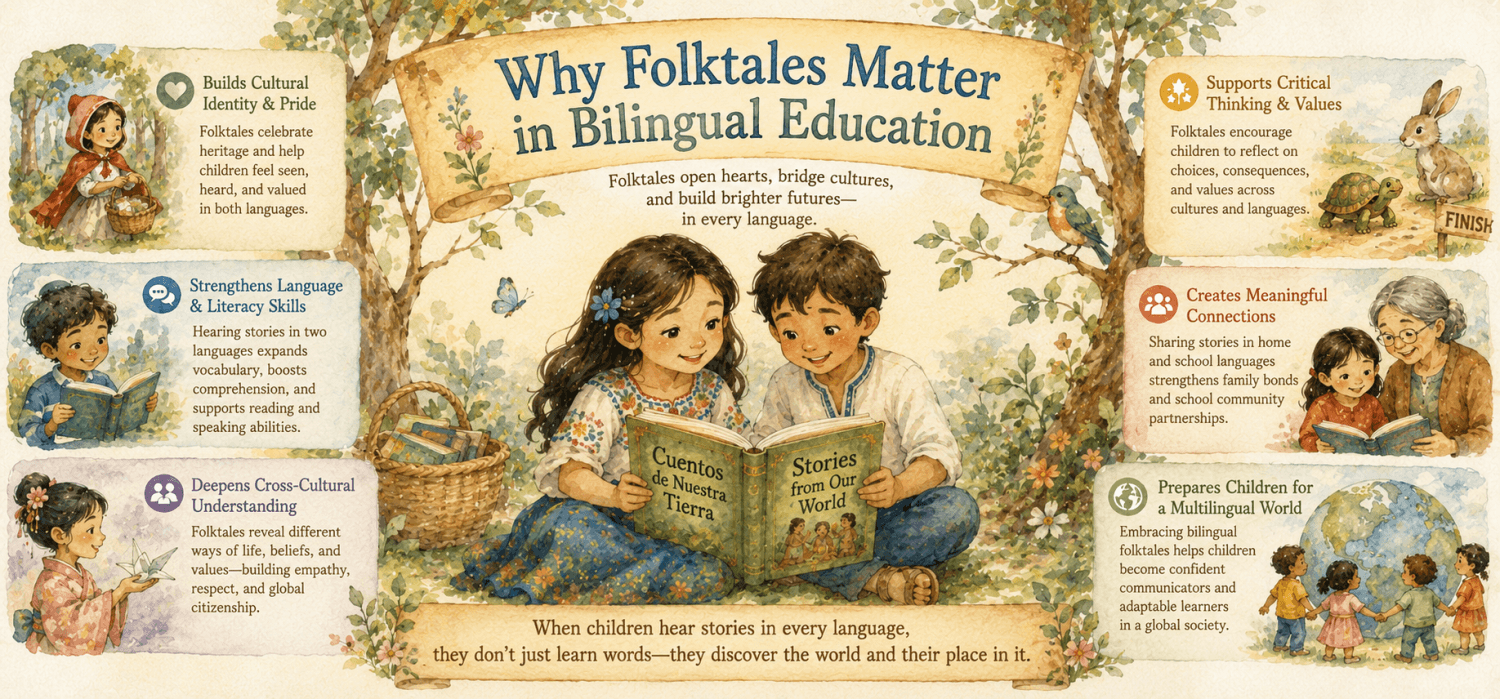
Understanding the Power of Stories Across Languages
Folktales are one of the most powerful tools educators can use in bilingual classrooms, yet their potential often goes untapped. These timeless stories, passed down through generations across cultures, do far more than entertain. They build linguistic bridges, reinforce cultural identity, and create a foundation for literacy development that resonates across multiple languages. For ESL educators working with diverse learners, folktales offer a unique pathway to language acquisition that engages not just the mind, but the heart.
The magic of folktales in bilingual education lies in their accessibility and universality. Unlike textbook dialogues about grocery shopping or weather forecasts, folktales carry emotional weight. They have memorable plots, vivid characters, and narrative structures that students naturally want to follow and retell. When a student hears about Anansi the Spider outwitting a leopard, or Momotaro the Peach Boy's heroic journey, they're motivated to understand—not because they have to pass a test, but because they genuinely care what happens next.
The Cognitive Benefits of Folktales for Bilingual Learners
Bilingual education research consistently shows that students who engage with culturally rich narratives develop stronger language skills in both their home language and their target language. This happens through several interconnected cognitive processes.
Language Acquisition Through Context
Folktales provide what linguists call "comprehensible input"—language that learners can understand because it's embedded in a meaningful, predictable context. When you tell the story of Cinderella, students don't need a dictionary to understand "mistreat" or "transform." The narrative arc shows them. This contextual learning is exponentially more effective than isolated vocabulary drills, and it sticks longer in long-term memory.
Cultural Schema and Deeper Understanding
When ESL students learn about their own cultural folktales in an English-speaking classroom, something profound happens: they see their heritage validated and celebrated. A Somali student studying "Aar and the Lion" alongside their American classmates learns that their stories matter, that their culture has wisdom worth exploring. This cultural affirmation boosts confidence and motivation—two critical factors for language learning success.
Moreover, studying different cultural folktales builds what educators call "cultural schema"—the knowledge frameworks we use to interpret the world. Students who know both European and Asian folktale traditions understand human nature more deeply because they've seen how different cultures address universal themes: good versus evil, wisdom versus foolishness, sacrifice versus selfishness.
Vocabulary Retention Through Narrative
Research on memory shows that we retain information better when it's emotionally charged and narrative-driven. Students may forget isolated vocabulary words within days, but a word encountered within the dramatic climax of a folktale—where the clever peasant exposes the greedy landlord, or the honest woodcutter is rewarded—becomes part of their long-term memory. The story becomes the mental hook that vocabulary hangs from.
Building Multilingual Competence Through Comparative Stories
One of the most effective techniques in bilingual education is comparing the same folktale across different languages and cultural versions. This practice, sometimes called "story mapping," develops critical multilingual awareness.
Consider Cinderella: English speakers know the Perrault version. But there's also the Chinese "Yeh-Shen," the Vietnamese "Tam and Cam," the Egyptian "Rhodopis," and many others. When students explore these variations, they notice patterns—the persecuted girl, the magical intervention, the test of identity—that appear across languages and cultures. This recognition builds metalinguistic awareness: students begin to understand how different languages express similar concepts, how cultural values shape storytelling, and how universal human themes transcend borders.
This comparative approach is particularly powerful for heritage language learners—students learning the language their grandparents spoke. Encountering folktales in their heritage language within an academic context demonstrates that the language is worthy of study, not just something spoken at home.
Eight Multilingual Folktales for Your Classroom
1. Anansi Stories (West African, particularly Ghanaian and Jamaican traditions)
Anansi the Spider appears in countless tales, with variations across West Africa and the Caribbean. His trickster nature makes him memorable, and stories like "Anansi and the Box of Stories" teach lessons about cleverness, greed, and wisdom. Available in English, Spanish, and French versions.
2. Momotaro (Japanese)
The tale of the Peach Boy who emerges from a giant peach to become a hero is beloved in Japan and taught across East Asia. This story teaches courage, loyalty, and the importance of community. Available in Japanese, English, and Mandarin Chinese.
3. The Panchatantra Tales (Sanskrit/Indian origin, spreading through Persian and Arabic)
These ancient animal fables, like "The Tale of the Monkey and the Crocodile," originated in Sanskrit and traveled along trade routes into Persian, Arabic, and eventually European literature. They're available in Hindi, English, Spanish, and French—making them perfect for tracing how stories migrate across languages.
4. Russian Folktales: "The Firebird"
This magical tale of Prince Ivan's quest for the golden Firebird enchants readers across Europe and beyond. Available in Russian, English, German, and Spanish, it demonstrates how Russian storytelling traditions emphasize magical realism and moral complexity.
5. "Issun Boushi" (Japanese: The One-Inch Tall Boy)
A smaller Japanese hero tale about a diminutive boy who triumphs through wit and courage. Perfect for discussions about size, power, and intelligence across cultures. Available in Japanese and English.
6. The Tale of Three Kingdoms (Chinese/Vietnamese)
Versions like "The Legend of the Grateful Tiger" show how similar stories circulate through East and Southeast Asia with cultural variations. Available in Mandarin, Vietnamese, and English.
7. Amos Tutuola's "The Palm-Wine Drinkard" (Nigerian/Yoruba)
This West African tale blends traditional folktale elements with a unique narrative voice. It's available in English and Yoruba, offering insights into how oral traditions are transcribed and how postcolonial literature reclaims indigenous stories.
8. "Clever Katya" (Russian/Slavic)
A Russian folktale about a clever peasant girl who outwits a tsar through intelligence and kindness. Available in Russian and English, it demonstrates how different cultures celebrate female cleverness and resourcefulness.
Practical Classroom Applications for ESL Educators
Story Circles and Oral Retelling
Rather than simply reading a folktale, have students sit in circles and retell it, with each student adding a sentence or paragraph in the target language. This transforms the story from a teacher-centered activity into an interactive, collaborative language practice. Students hear multiple pronunciations, different word choices, and diverse interpretations—all supporting language growth.
Dual-Language Story Mapping
Create visual maps of folktales in both the student's home language and English. Vocabulary appears on the map in both languages, with images showing the sequence of events. This bridges languages rather than replacing one with the other, honoring the student's bilingual reality.
Comparative Writing Projects
Have intermediate or advanced ESL students write essays comparing two versions of the same tale. Why does the Chinese Cinderella story emphasize respect for ancestors? Why is the African Anansi cleverer than the European Aesop's foxes? These questions develop both language skills and cultural analysis.
Folktale Reader's Theater
Students perform folktales as Reader's Theater—a script-based performance that requires minimal props but maximum engagement with language. Students practice fluency, intonation, and expression while building confidence in public speaking.
Heritage Language Integration
When you feature folktales from students' heritage cultures, invite families to visit the classroom or send in recordings of stories in the home language. This positions families as language experts and creates authentic audiences for language use.
The Equity Dimension
Using folktales in bilingual education is fundamentally an equity issue. Students from dominant culture backgrounds grow up hearing their stories reflected in school curricula. Their grandmothers' tales become literature; their languages are prestigious. For students from immigrant, refugee, or indigenous backgrounds, folktales offer something powerful: proof that their stories, languages, and cultures have value in an academic space.
When a Somali student's great-grandmother's tale about camels and wisdom is studied alongside Aesop, when a Vietnamese student hears "Tam and Cam" taught with the same respect as "Cinderella," when a Navajo student presents a creation story in their ESL class—something shifts. Language learning becomes less about assimilation and more about expansion. Students aren't abandoning their linguistic home; they're building an additional room.
Conclusion: Stories as Bridges
Folktales have survived centuries because they work. They work at teaching values, at explaining human nature, at preserving culture, and yes—at teaching language. For ESL educators, folktales represent a practically unlimited resource for engaging, meaningful language instruction that simultaneously validates student identities and builds genuine proficiency.
The question isn't whether folktales matter in bilingual education. The evidence overwhelmingly suggests they do. The question is: how quickly can we integrate them into every classroom where multilingual learners are building their linguistic futures? In a world where children navigate multiple languages and cultures daily, folktales offer them something precious—the knowledge that their heritage is a foundation, not a barrier, to their success.