
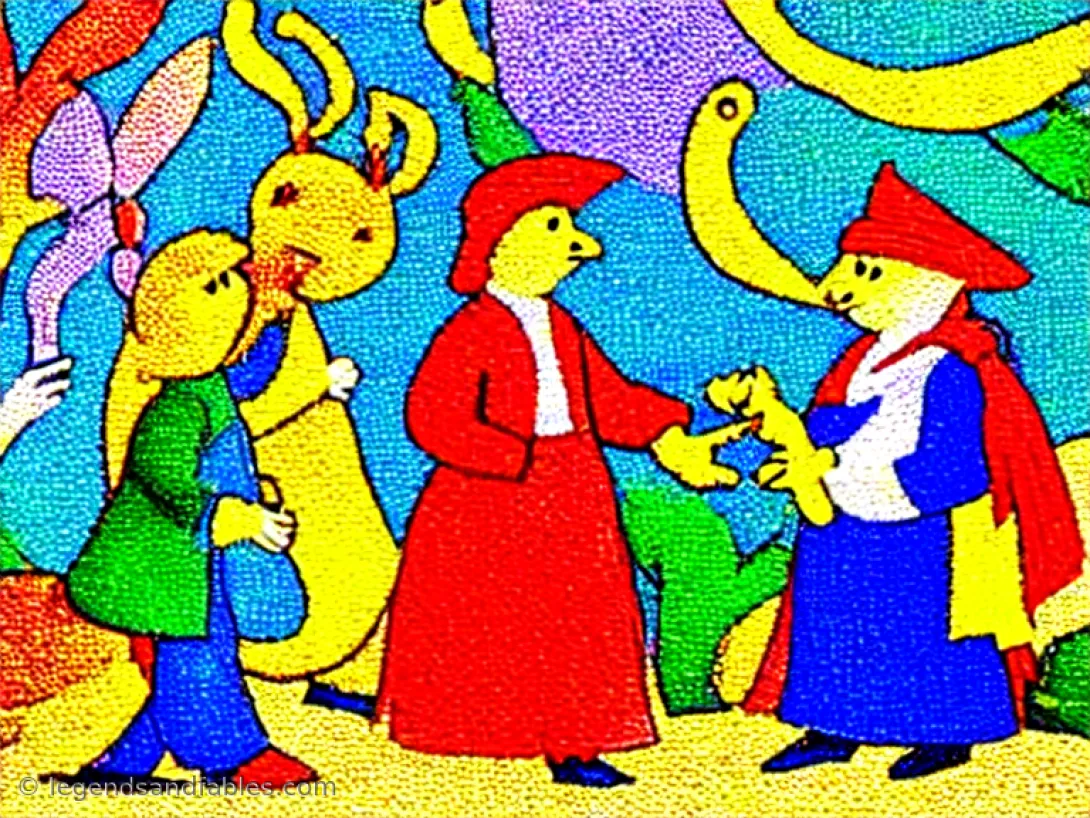
In the kingdom of Akbar, there lived a clever court jester named Birbal. He was known for his quick wit and sharp tongue, which often got him into trouble with the foolish courtiers who surrounded Emperor Jalal-ud-din Muhammad Akbar.
The emperor had invited many sages from far-off lands to come and share their wisdom with him. Among them was a wise old sage named Raja Todar Mal, who was known for his cleverness. However, not everyone at court was as wise as he seemed.
One day, while Emperor Akbar was away, Birbal decided to test the foolish courtiers' knowledge. He pretended to be an ignorant traveler and asked them a series of silly questions. The courtiers, eager to impress the emperor, began to answer his questions with great confidence.
They told him that the sun traveled on a chariot drawn by horses, that the earth was flat, and that the sea was made of sweet water. Birbal listened carefully, making sure to keep a straight face. He then asked them how they knew all this.
One courtier, who thought he was very clever, said, "We know it because we have read it in an ancient book!" Another courtier chimed in, "Yes, and the book is written on animal skin!"
Birbal pretended to be amazed by their knowledge and asked if he could see the book. They proudly showed him a large stone with some strange symbols etched onto its surface. Birbal examined the stone carefully, making sure not to reveal his true identity.
Just then, Raja Todar Mal appeared at court and overheard Birbal's conversation with the foolish courtiers. He smiled knowingly and asked Birbal what he was doing. Birbal explained that he had been testing the knowledge of the courtiers.
Raja Todar Mal chuckled and said, "Ah, I see you have been trying to teach them a lesson, Birbal!" Birbal nodded in agreement, and Raja Todar Mal continued, "Well, let us not forget that even the wisest among us can be foolish at times."
The courtiers looked embarrassed, realizing too late that they had made fools of themselves. Emperor Akbar returned to the palace and was told about the incident. He smiled and said, "I am glad to see that my courtiers have a sense of humor!"
Birbal bowed low, relieved that his prank had not caused any harm. The foolish courtiers slunk away in shame, but Birbal knew that they would never forget the lesson he had taught them: wisdom is not just about reading books or knowing things, it's also about being humble and learning from others.
The story of Birbal and the foolish courtiers spread throughout the kingdom, reminding everyone that even the cleverest among us can benefit from a little bit of humility.
💡 Life's Lesson from this story
Pride and arrogance can lead to downfall and loss of dignity always.
🗺️ Cultural Context
📚 Word of the Story
- Foolishness — being silly or stupid
- Courtiers — people who serve a king or queen
- Mischief — trouble or naughty behavior
💬 Let's Talk About It
What qualities made Birbal so clever in solving the riddle given by King Akbar?
How do you think the courtiers would have reacted if they had accepted their foolishness and apologized to Birbal instead of becoming proud of their ignorance?
Do you think it is fair that the king punished the courtiers for being dishonest, or should he have shown them mercy?