
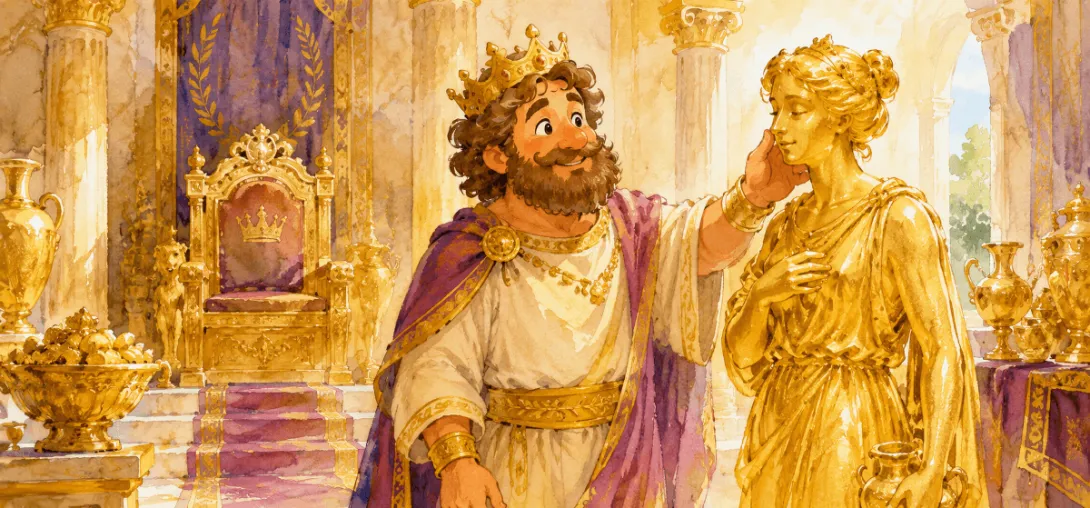
King Midas was a wealthy ruler of Phrygia, known for his extravagant feasts and lavish lifestyle. His palace was filled with precious jewels and golden artifacts, and he loved to spend his days surrounded by the finest things in life.
One day, while out for a stroll, King Midas met the enigmatic Silenus, a wise satyr from ancient Greece. Silenus was renowned for his incredible wisdom and knowledge of the gods. The king, fascinated by the satyr's stories of the divine, begged him to share one final gift with him before they parted ways.
Silenus, pleased by King Midas' genuine interest in the world beyond his palace walls, agreed to grant him a single wish. "What is it that you desire most?" he asked the king. Without hesitation, King Midas requested the ability to turn everything he touched into solid gold.
To his amazement, Silenus nodded and whispered a magical incantation. From that moment on, King Midas' fingers seemed to possess an extraordinary power – whenever he touched something, it would transform into glittering gold.
At first, the king was ecstatic by his newfound ability. He turned flowers into bouquets of gold, rocks into golden pebbles, and even his favorite foods into golden delicacies. His palace became a dazzling spectacle, attracting visitors from far and wide who marveled at its splendor.
However, as time passed, King Midas began to realize the cruel irony of his gift. His beloved daughter, Pyraea, laughed and cried whenever he tried to hug her, her very skin turning into cold, unyielding gold. The air grew thick with the scent of golden dust as everything – trees, rivers, even the stars in the night sky – became tainted by his touch.
Desperate for a solution, King Midas sought out Silenus once more, begging him to reverse the curse. The satyr listened patiently and then offered words of wisdom: "A gift is only valuable if it brings joy and balance to one's life, not just riches and wealth." With those words still echoing in his mind, King Midas focused on using his power for good.
He created golden statues of his ancestors to honor their memories, gold bridges to connect the land with its natural beauty, and even a golden crown to signify his love for Pyraea. By embracing the essence of Silenus' gift, King Midas learned that true wealth lies not in material possessions but in the connections we make with others and the harmony we maintain within ourselves.
As he returned to his palace, his heart filled with newfound appreciation for life's simple joys, King Midas realized that sometimes it takes a magical touch to discover what truly matters.
💡 Life's Lesson from this story
Greed can lead to losing what truly matters in life.
🗺️ Cultural Context
📚 Word of the Story
- Midianite — a person from Midian, an old place in the Bible
- Famine — a time when there is not enough food for people to eat
- Sacrifice — giving up something valuable as a way of showing respect or making amends
💬 Let's Talk About It
What did King Midas learn about the value of things when his touch turned everything to gold?
How do you think King Midas felt after he realized that his golden touch was a curse, rather than a blessing?
Can you think of times in your own life when something unexpected happened and it made you realize what's truly important?