
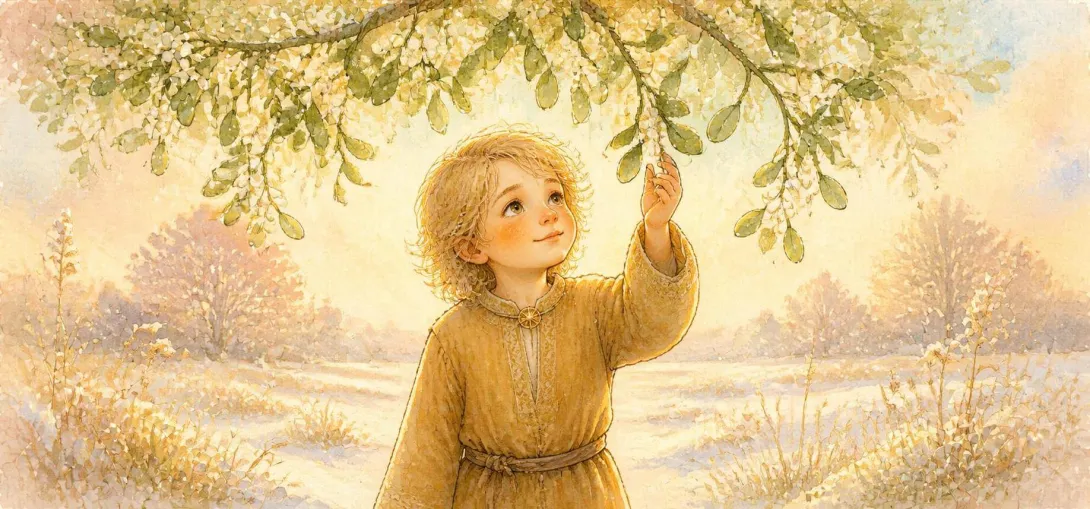
In the land of Asgard, where gods and goddesses dwelled in splendor, there lived a god so radiant that his name was synonymous with beauty: Baldur the Beautiful. His laughter was like sunshine, and his smile could light up even the darkest of skies. The other gods adored him, and the mortals revered him.
Baldur's mother, the All-Mother Freyja, loved her son more than life itself. She prayed to the great Norns – Urðr, Verðandi, and Skuld – to weave a protective spell around Baldur, ensuring his safety from harm. But, alas! The mischievous Loki, disguised as an old crone, overheard Freyja's plea.
Loki crept into the sacred grove of Iðavöllr, where the mistletoe bloomed with eerie silence. He whispered a deceitful charm to the plant, infusing it with dark magic. When Baldur played outside with his sister Hlín, Loki snuck up behind them and tricked Baldur into picking a sprig of mistletoe from his belt. Unbeknownst to Baldur, this was no ordinary plant – it held the power to wound even the gods.
The very moment Baldur touched the mistletoe, he felt an unseen pain pierce through his heart. He stumbled and fell, his radiant light fading into darkness. The other gods rushed to his side, horror-stricken by the sight of their beloved leader dying before them.
As news of Baldur's passing spread throughout Asgard, the world mourned. Even the usually stoic Thor was overcome with grief. But then, a glimmer of hope emerged: Freyja remembered an ancient prophecy that foretold the gods' doom if Baldur fell. The Norns themselves had woven this fate into the fabric of destiny.
Moved by her son's sacrifice, Freyja wept tears of gold and silver, which poured onto Baldur's still form. His life force revived, but alas! His beauty was now tinged with sorrow. From that day on, whenever a sprig of mistletoe was brought before the gods, they would shudder in memory of the pain it had caused their beloved Baldur.
The story of Baldur and the Mistletoe teaches us that even the smallest actions can have far-reaching consequences. And though beauty and love may shield us from harm for a time, ultimately it is our choices and intentions that shape our fate – and those around us.
💡 Life's Lesson from this story
Innocence and arrogance can be a deadly combination in life's balance.
🗺️ Cultural Context
📚 Word of the Story
- Betrayal — to break a promise or trust someone
- Mistletoe — a type of plant with white berries that grows on trees
- Rival — someone who competes against you in sports, games, or other activities
💬 Let's Talk About It
What do you think Baldur's friends felt when he was hurt by the mistletoe?
How does the story show that love can be both strong and gentle at the same time?
Can you think of a situation where wisdom helped someone make a difficult choice, just like Odin's wisdom helped him understand what had happened to Baldur?